
25 Years of GeSI Part 3: From Responsible to Business Value driven Supply Chains – GeSI’s Evolving Role in a Changing Industry
Missed part 1? You can catch up here.
Missed part 2? You can catch up here.
For global business today, supply chains are no longer just operational systems. They have become a key test on how companies manage risk, build trust, respond to regulation, innovate, ensure quality, and create long-term value. Questions of sourcing, transparency, resilience, circularity and digital traceability now sit much closer at the centre of strategic decision-making.
This is what makes GeSI’s long engagement with supply chain responsibility especially relevant. What began in GeSI’s early years as a collective effort to address supplier standards, labour conditions, environmental impacts and responsible sourcing has, over time, developed into a broader understanding of digitally enabled value chains—more connected, more accountable, more innovative and increasingly central to how sustainable growth is created and governed.
Extending Responsibility Across the Value Chain
From the beginning, GeSI recognised that the sustainability footprint of the ICT sector could not be understood by looking only at direct operations. In its early work, the industry was already described as part of a complex value chain stretching from raw material extraction through refining, component production, assembly, distribution and use. The point was straightforward: responsibility did not begin and end at the company boundary.
That understanding shaped GeSI’s early priorities. By the early 2000s, supply chain management had already emerged as a shared challenge for ICT companies, and GeSI established a supply chain working group to help members move towards a more common approach. The aim was clear from the start: by working together Gesi members could reduce duplication across company codes and questionnaires, benchmark emerging practice, and build a stronger sector-wide response grounded in internationally recognised principles on human rights, labour and the environment.
This early work developed alongside GeSI’s collaboration with the Electronic Industry Citizenship Coalition (EICC) in the creation of E-TASC (E-TASC (Electronics-Tool for Accountable Supply Chains) —a robust industry tool designed to establish a common approach for demonstrating corporate social responsibility in supply chain management. It enabled companies to assess and identify risks, while driving performance and continuous improvement across their operations. This initiative later evolved outside of GeSI into what is now known as the RBA-Online Risk assessment Tool.
This is significant, as it highlights that GeSI’s focus on supply chains was never peripheral. Rather, it formed part of the early architecture through which the sector began to define a more consistent and structured approach to responsible business across global supply chains.
Conflict Minerals and the Rise of Supply Chain Accountability
Among the issues that came to define this period, conflict minerals stood out as one of the most consequential.
The issue made visible something the sector could no longer ignore: global supply chains were under the radar as environmental damages, human rights concerns and wider questions of business legitimacy started to be questioned by policy makers and other stakeholders. In the Democratic Republic of Congo, the mining of coltan (tantalum), an ore used in mobile phone batteries, revealed the extent to which digital and other industries are tied to realities that can no longer be ignored.
GeSI’s response was proactive, transparent, and forward-looking. GeSI went beyond the general concern and took immediate action, shaping the sustainability agenda. In 2003, the GeSI Board commissioned an investigation to Fauna & Flora International, a conservation charity which purpose is to protect the diversity of life on Earth, for the survival of the planet and its people, to run an independent investigation and to propose clear mitigation measures. The outcome was an outstanding report: “Coltan Mining in the Democratic Republic of Congo: How tantalum-using industries can commit to the reconstruction of the DRC”. That report became an early milestone in the sector’s understanding of responsible sourcing. More importantly, it helped shift the discussion away from simple avoidance towards the harder question of what a legitimate and longer-term response should look like.
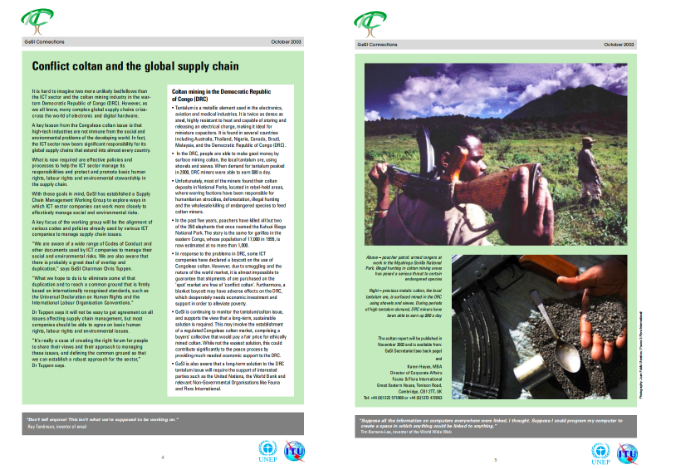
Content on Conflict Minerals in GeSI’s First Newsletter (2003)
This line of work later developed into more formal collaboration with the electronics industry. In 2012, GeSI and the EICC jointly released Version 2.0 of the Conflict Minerals Reporting Template to support disclosure and communication about smelters and refiners in company supply chains. In 2013, the two organisations also launched the Conflict-Free Sourcing Initiative, today known as the Responsible Minerals Initiative (RMI) replacing the earlier GeSI-EICC Extractives Working Group as this collaboration expanded to include a wider set of stakeholders and sectors.
This is significant and shows GeSI’s vision, forward looking and innovative approaches at a time when no other industry sector had taken any action. GeSI and its members took responsibility and moved beyond a narrow compliance frame.
From Supply Chain Responsibility to Digital Value Creation
Supply Chains have been evolving rapidly, as technology has. This transformation requires a fundamental shift if our industry is to maintain leadership. Through strong collaboration and a shared understanding of the challenges ahead, significantly greater impact can be achieved. While tools of the past might still answer some of the old problems, they are far from being appropriate to respond to the new challenges ahead. This is why supply chains remain one of the key areas of GeSI’s work—but the agenda has changed.
For many years, supply chain practice in the sector was largely compliance-driven: supplier codes, audits, corrective action plans, labour standards, and later climate-related reporting and Scope 3 expectations. Those elements still matter, but they are no longer enough on their own, and above all they do not respond to the pressing challenges that we are confronted with. Those practices may serve reporting and communication purposes, but they are not driving business value, improving quality, or accelerating innovation. We need a fundamental shift in paradigm.
As digital transformation accelerated and supply chains became more interconnected, the conversation moved beyond sourcing risk and supplier oversight alone. New questions emerged around circularity, lifecycle design, product-level data, Scope 3 visibility, and the role of digital systems in coordinating increasingly complex supplier ecosystems. Regulation is also reshaping the landscape, pointing towards a future in which traceability, material information and lifecycle transparency are more deeply embedded in how products are designed, traded and governed.
This marks a broader transition—from responsible supply chains to digital value chains.
A digital value chain is not simply a more efficient supply chain supported by technology and by strong collaboration. It is a system in which data, connectivity, analytics, automation and governance increasingly shape how value is created, managed, and sustained. In that context, sustainability is no longer only about reducing harm. It becomes part of how competitiveness, trust, resource efficiency, and resilience are built into the structure of value creation itself.
From Interdependence to Resilience: The Next Phase of Digital Supply Chains
This evolution is now entering a new phase.
The next chapter cannot be framed only in terms of compliance. Digital supply chains are being reshaped by geopolitical volatility, climate risk, circular economy requirements, product-level traceability, AI-enabled decision systems and rising expectations for transparency across Scope 3 emissions and supplier performance.
That is why GeSI’s current work matters. The Digital with Purpose Global Summit 2026 will take place in Shenzhen, China, and the location is far from incidental. Over decades, China has become central to global production networks, while Shenzhen has emerged as a major hub for advanced manufacturing, ICT innovation and digital infrastructure. If meaningful dialogue on the future of digital supply chains is to take place, it must include the regions and ecosystems where these supply chains are most deeply anchored.
In this context, Shenzhen will also host the inaugural Digital with Purpose Supply Chain Awards, recognising companies redefining supply chain leadership through the convergence of digital innovation, intelligent infrastructure and responsible business practice.
Alongside the awards, GeSI is preparing a Supply Chain White Paper focused on the evolving challenges of sustainable ICT supply chains and new value driven collaboration models. The intention is practical: to identify key the opportunities, highlight leading practices, and show where digital tools can make a measurable difference—including digital traceability, cross-border data governance, supply chain transparency and capacity building for suppliers and SMEs.
The next phase of digital supply chains will not be defined by compliance alone. It will be shaped by how effectively companies work together, connect responsibility with resilience, digital capability with trust, and operational performance with long-term value creation.
Seen in that light, GeSI’s supply chain history is not simply a record of past initiatives. It reflects a deeper shift on how the digital industry has come to understand responsibility itself—from managing supplier risk to rethinking how value chains are designed, governed and sustained. As the pressures on global supply chains continue to grow, the need for more transparent, more intelligent and more responsible systems will only become more urgent.
Become a member and get access to all special member content with the best insights of tech and sustainability issues today.