
The GeSI’s SMARTer 2030 Vision: 25 Years of GeSI
Harnessing the Enabling Impact of Digital Technologies and realize the 20% CO2 Emission Reduction and USD $11 Trillion Opportunity
As AI, data centres and digital infrastructure continue to expand, the conversation around sustainability for the digital industry needs to focus onhow digital technologies grow responsibly while creating greater value for people, the economy and the planet.
Since 2008, GeSI’s SMART reports have helped shape one of the most important debate in digital sustainability: the impact of digital technologies should and can not be assessed only by what the sector consumes, but above all by what it enables across the wider economy.
This was a significant shift. It moved the conversation beyond the footprint of ICT toward its enabling role in reducing emissions, improving efficiency, generating financial gains, and support more sustainable systems in different sectors of the global economy and the sector itself.
SMART 2020: reframing the role of ICT
Published in 2008, SMART 2020: Enabling the low carbon economy in the information age made for the first time a clear case that ICT was not the problem but the solution for climate change.
The report estimated that ICT-enabled solutions could deliver 7.8 GtCO2e in emissions savings by 2020, equivalent to around 15% of projected global business-as-usual emissions. At the time, this was a powerful message: the enabling potential of digital technologies could be many times greater than the sector’s own direct footprint.
SMART 2020 also showed where this impact could come from. It pointed to opportunities across power, buildings, transportation and industry, where digital technologies could help improve energy efficiency, reduce waste and water and support better decision-making.
In doing so, the report helped reframe ICT as a system-wide enabler of decarbonisation.
SMARTer 2020: strengthening the evidence
In 2012, GeSI built on that work with SMARTer 2020: The Role of ICT in Driving a Sustainable Future. The updated analysis strengthened the case.
The report estimated that ICT-enabled solutions could reduce projected 2020 global greenhouse gas emissions by 16.5%, or 9.1 GtCO2e. It also identified up to US$1.9 trillion in annual gross energy and fuel savings. The potential emissions abatement was more than seven times the ICT sector’s own emissions. The message was clear:
Better use of digital technologies could reduce emissions, lower costs, improve productivity and strengthen long-term competitiveness.
Digital technologies were not simply tools for incremental efficiency. They were becoming a strategic infrastructure for a low-carbon economy.
SMARTer2030: expanding the agenda
In 2015, SMARTer2030: ICT Solutions for 21st Century Challenges extended the horizon to 2030 and broadened the ambition.
The report estimated that ICT could enable a 20% reduction in global CO2e emissions by 2030, equivalent to around 12 GtCO2e of avoided emissions. It also projected more than US$11 trillion in economic benefits from ICT-enabled solutions ,shared between the ICT industry itself but also with all the other analysed relevant sectors. A clear “win-win”
Unlikely the previous reports SMARTer 2030 went looking to other potential opportunities beyond carbon. It co-related digital technologies to wider development outcomes, including health, agriculture, education and access to essential services. The report highlighted, for example, the potential to extend e-health access to 1.6 billion people and increase agricultural yields by around 30%.
This marked an important evolution in GeSI’s work. The question was no longer only how digital technologies could reduce emissions. It was how they could support a more sustainable, productive, and inclusive economy.
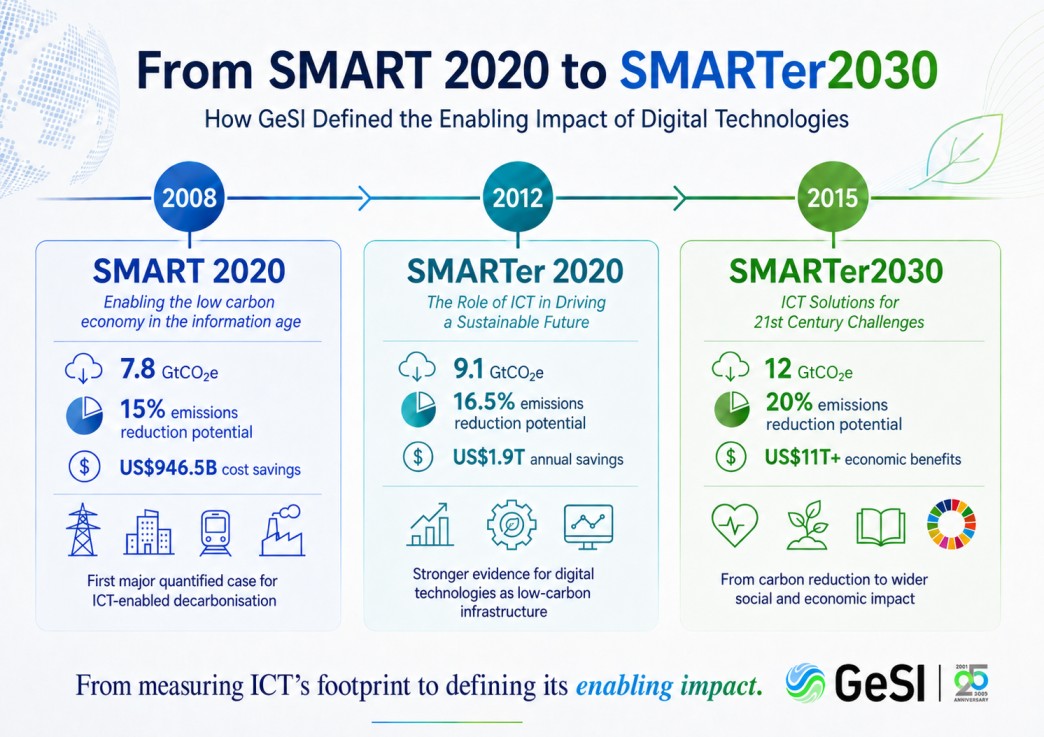
A clear evolution
Across the three reports, the progression is clear.
In 2008, SMART2020 estimated that ICT could enable 7.8 GtCO2e of emissions savings by 2020, or around 15% of projected global emissions, while ICT-enabled energy efficiency could translate into approximately €600 billion, or USD$946.5 billion, in cost savings.
In 2012, SMARTer 2020 updated that potential to 9.1 GtCO2e, or 16.5%, with US$1.9 trillion in annual energy and fuel savings.
In 2015, SMARTer2030 extended the horizon to 2030, estimating a 20%reduction in global CO2e emissions, around 12 GtCO2e, and more than US$11 trillion in economic benefits. This 10x the ICT own footprint.
These reports did more than publish projections. They gave structure to a principle that continues to guide GeSI’s work today: digital technologies must be judged by both their footprint and their enabling impact.
Why it matters today
That perspective is especially relevant now.
The growth of AI and digital infrastructure is creating real pressure on energy, water and materials. These issues cannot and should not be ignored. They require better design, deployment and stronger collaboration across industry, policy and finance.
But the SMART series reminds us that the sustainability discussion should not stop at resource demand. A complete assessment must also consider what digital technologies make possible: smarter grids, more efficient buildings, cleaner mobility, more transparent supply chains, better climate data, improved water management and more resilient public services.
This is also the link between GeSI’s earlier thought leadership and its work today.
Digital with Purpose, the European Green Digital Coalition, the United Nations Solutions Hub, the Datacentres, Energy and Water Working Group, and the Water Digitalization Initiative all build on the same underlying logic: digital technologies have value when they deliver measurable outcomes beyond the technology sector itself.
The focus has now moved from proving potential to enabling implementation.
From potential to implementation
The legacy of the SMART reports is not historical. It’s strategic and actual.
They helped define why digital technologies matter for sustainable development, where they can create value, and why their impact must be measured across systems.
For GeSI, the next phase is about turning that logic into practice: helping companies, governments and partners make the enabling impact of digital technologies more credible, measurable, and deployable.
That is the journey from SMART 2020 to SMARTer2030 — from thought leadership to real-world and tangible impact.
Become a member and get access to all special member content with the best insights of tech and sustainability issues today.