
25 Years of GeSI Part 2: When Digital became the Fundamental Infrastructure
Missed part 1? You can catch up here.
When Digital became the fundamental infrastructure: GeSI evolved to be the system Orchestrator and industry aggregator for the future AI Economy
As we look back on 25 years of GeSI’s history, one period stands out as a defining inflection moment— a structural shift that reshaped the organisation’s trajectory and redefined its role. By the early 2020s, digital transformation had moved beyond the boundaries of a single industry. Digital systems have become infrastructure: embedded across energy systems, transport networks, logistics, manufacturing, finance, healthcare, agriculture, and public governance, fundamentally reshaping how global economies operate and how sustainability challenges must be addressed. The institutional response to this new reality crystallised in December 2022, at an historic Board meeting at Verizon premises in Washington DC, chaired by Jim Gowen, when GeSI formalised a transformation that had been building over several years — evolving from a single sector platform into a system-level institution.
In 1999, GeSI emerged from a simple question around industry responsibility. The early years were defined by building credibility through action—pioneering work on supply chain accountability, conflict minerals, sustainability standards, and the sector’s role in climate action. By the late 2000s, that first phase had established GeSI as a trusted platform for aligning industry practice with emerging sustainability expectations.
From 2008 onward, GeSI entered a second phase shaped by thought leadership. The SMART reports (2008, 2012, 2015)—alongside a wider body of research and guidance—helped quantify how digital technologies can enable emissions reductions and broader sustainable development outcomes across the economy. This shift from compliance-oriented responsibility to evidence-based enablement laid the foundation for what GeSI would become in the next decade.
By 2019, the context had fundamentally changed. Digital infrastructure was no longer confined to a sector. Telecommunications networks were no longer simply communication channels; they had become foundational to energy grids, transport systems, finance, healthcare, agriculture, and public administration. The term “ICT sector” no longer captured the structural role digital systems played in the global economy.
For GeSI, this was not semantic. It was institutional.
As Luís Neves reflects, by 2018 the strategic implications were unavoidable: digital technologies were embedded across systems. If sustainability risks were increasingly systemic, responsibility — and action — could no longer remain sectoral.
Over nearly two decades, GeSI built a strong credibility: pioneering and advancing supply chain accountability, leading on sustainability policy in areas such as conflict minerals, innovating on standardization, supporting reporting alignment, and engaging in promoting the enabling role of digital to address climate change. However, the adoption of the UN Sustainable Development Goals and the Paris Agreement fundamentally shifted expectations — from advocacy and guidance toward measurable implementation at speed and scale. At the same time, digitalisation accelerated rapidly, outpacing existing governance frameworks and creating new systemic challenges.
The question was no longer whether digital transformation mattered. The question was whether GeSI’s institutional design matched the scale of its era.
I. The 2018–2019 Reset: From Mitigation to Enablement
Following on the previous remarkable and breathtaking SMART reports from 2008, 2012 and 2015, the GeSI Board initiated in 2018 a strategic review of the organisation’s long-term positioning. The debate was measured and rooted in governance. There was no intention to abandon GeSI’s ICT foundation. The challenge was to determine whether a sector-based structure could credibly address cross-sector sustainability challenges in a world increasingly shaped by digital systems.
The launch of the Digital with Purpose report and framework in 2019 marked the conceptual shift. Rather than focusing primarily on how technology reduces its own footprint, Digital with Purpose articulated how digital innovation can enable climate action, social inclusion, and economic growth and resilience across industries.
The reframing clarified the ambition. But it did not yet complete the institutional transformation.
II 2022: Formalising the Institutional Change
In January 2022, GeSI launched a revolutionary “Organisational Strategy Refresh” with a clear objective: redesign the organisation so it could operate beyond the traditional ICT sector harnessing the growing integration and the enabling potential of digital technologies across all industries to drive systemic change

GeSI CEO Luis Neves
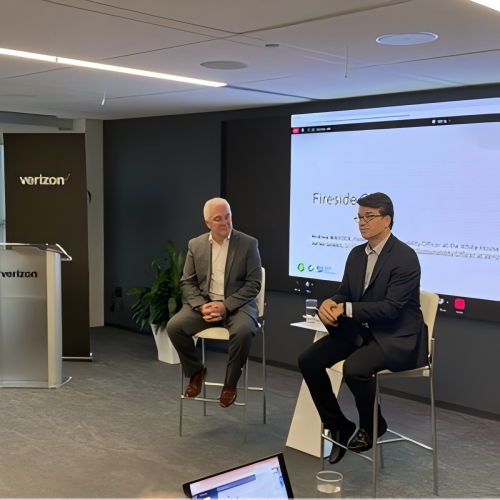
GeSI Chairman Jim Gowen
The shift that followed was structural:
- Membership expanded to welcome organisations beyond the traditional telecommunications and ICT industry.
- Positioning moved from a sector association to a cross-industry, multi-stakeholder platform.
- Governance and Secretariat were reviewed to support broader systemic engagement and to support increasing membership demands
- Strategic focus was sharpened to reflect a rapidly evolving sustainability and digital governance landscape.
In practical terms, GeSI moved from representing a sector to convening systems.
This was the institutional shift.
III. After the Change: A Three-Layer Model of System Action
Following the 2022 redesign, GeSI’s work increasingly cohered around a structured, cross-industry delivery model—organised across three interconnected layers: Programmes, Platforms, and Partnerships. Together, they form a system-action architecture that remains member-driven, while scaling implementation through proprietary movements and cross-sector collaboration.
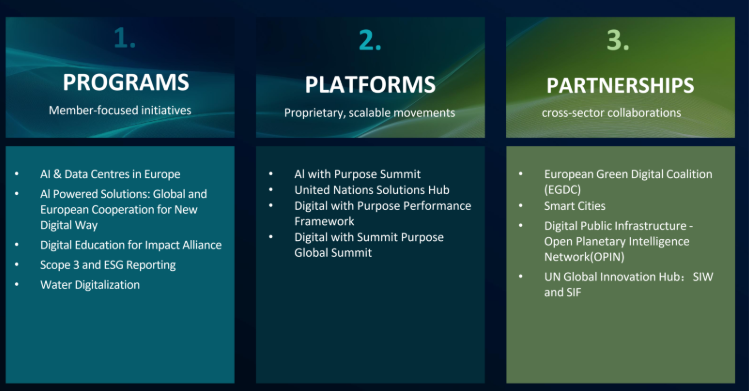
PROGRAMMES (Member-focused initiatives)
At the programme level, GeSI remains strongly member-focused and delivery-oriented—developing practical guidance, shared methodologies, and measurable approaches that strengthen sustainability performance across value chains.
Scope 3 and ESG Reporting is a core pillar. Through work such as the Scope 3 Guidance for Telecommunication Operators (with GSMA and ITU), GeSI provides a structured approach to address indirect emissions across the value chain, improving consistency in measurement, management, and disclosure.
Water Digitalization is a strategic programme responding to intensifying global water stress. It positions digitalisation as an enabler of adaptive, data-driven water governance, supporting more resilient management as scarcity, quality risks, and climate volatility increase.
Digital Education for Impact Alliance (DEFIA) (launched in 2025) advances education as a critical enabler of sustainable development—convening global experts and members to explore how digital transformation is reshaping skills and lifelong learning in support of the SDGs, while creating pathways for member-led subprogrammes that translate shared insight into action.
GeSI’s programme portfolio also expanded into two defining frontiers of the AI era: AI Powered Solutions: Global and European Cooperation for New Digital Way, supporting Europe’s coherent AI direction through cross-sector alignment, measurable indicators, and an EU AI Country Tracker approach; and AI & Data Centres in Europe, providing near-term guidance on sustainable AI infrastructure across energy, water, circularity, siting, and governance.
PLATFORMS (Proprietary, scalable movements)
If programmes drive member delivery, platforms scale visibility, participation, and adoption through GeSI’s proprietary convening and assessment mechanisms.
The Digital with Purpose Global Summit is the flagship convening mechanism of the DWP movement, mobilising leaders and solutions around digital technologies as enablers of the 2030 Agenda and the SDGs.
The Digital with Purpose Performance Framework operationalises ambition through a sustainability maturity assessment, creating a shared performance language across members.
In parallel, the AI with Purpose Summit extends this platform logic to responsible, inclusive, purpose-driven AI.
GeSI also launched the United Nations Solutions Hub (UNSH) (with the UNFCCC Global Innovation Hub, launched at COP30) to bridge the implementation gap—aligning climate priorities with deployable, technology-enabled solutions and collaboration pathways for scalable delivery.
PARTNERSHIPS (Cross-sector collaborations)
Partnerships translate programme expertise and platform momentum into policy alignment and cross-sector implementation. Through the European Green Digital Coalition (EGDC), GeSI helps link digital solutions with credible impact measurement and deployment approaches.
Through Smart Cities collaboration, it reinforces cities as climate action accelerators where digital solutions improve resilience, efficiency, and service delivery.
GeSI’s partnership with the United Nations Global Innovation Hub strengthens the interface with UNFCCC processes.
Finally, GeSI contributes to Digital Public Infrastructure: Open Planetary Intelligence Network (OPIN), supporting open, interoperable DPI for data-driven, inclusive, scalable climate action.
IV. Institutional Durability
The period from 2018 to 2022 was not a rupture with GeSI’s origins. It was a structural adaptation to a new digital reality.
“Without that shift,” Luís notes, “GeSI would likely have remained relevant to an industry. With it, we became relevant to systems.”
That distinction defines GeSI today.
GeSI is no longer defined solely by the sector from which it originated. It is defined by the role digital infrastructure plays in sustainable development—and by its capacity to convene actors across industries to steward that role responsibly, measurably, and at scale.
The institutional identity changed in 2022.
The mission expanded.
The evolution continues.
Become a member and get access to all special member content with the best insights of tech and sustainability issues today.