
GeSI Member Spotlight: Google Green Light
From Traffic Congestion to Smarter, Lower-Emission Cities
What if cities could reduce congestion and emissions without building anything new? Project Green Light shows that with AI and data, existing infrastructure can be transformed into a smarter, lower-emission system—turning digital innovation into immediate climate action.
Google’s Project Green Light uses AI and Google Maps data to optimise traffic signals, reducing stop-and-go traffic. Already deployed in 20+ cities globally, the solution has achieved up to 30% fewer stops and 10% lower emissions, demonstrating scalable digital impact in urban mobility.
- The Challenge
Urban transport is one of the largest contributors to global greenhouse gas emissions, with road traffic accounting for a significant share of urban pollution.
A key driver of inefficiency is stop-and-go traffic at intersections, where:
- vehicles idle unnecessarily
- repeated acceleration increases fuel consumption
- congestion compounds across interconnected roads
Stop-and-go driving generates significantly higher emissions than smooth-flow traffic, making traffic signal optimisation a critical—yet often underutilised—lever for decarbonisation.
Despite this, many cities still rely on static or outdated traffic light systems, which:
- are not responsive to real-time conditions
- require manual optimisation
- lack data-driven insights at scale
Cities therefore face a structural challenge: how to improve traffic flow and reduce emissions without costly infrastructure upgrades.
- The Solution
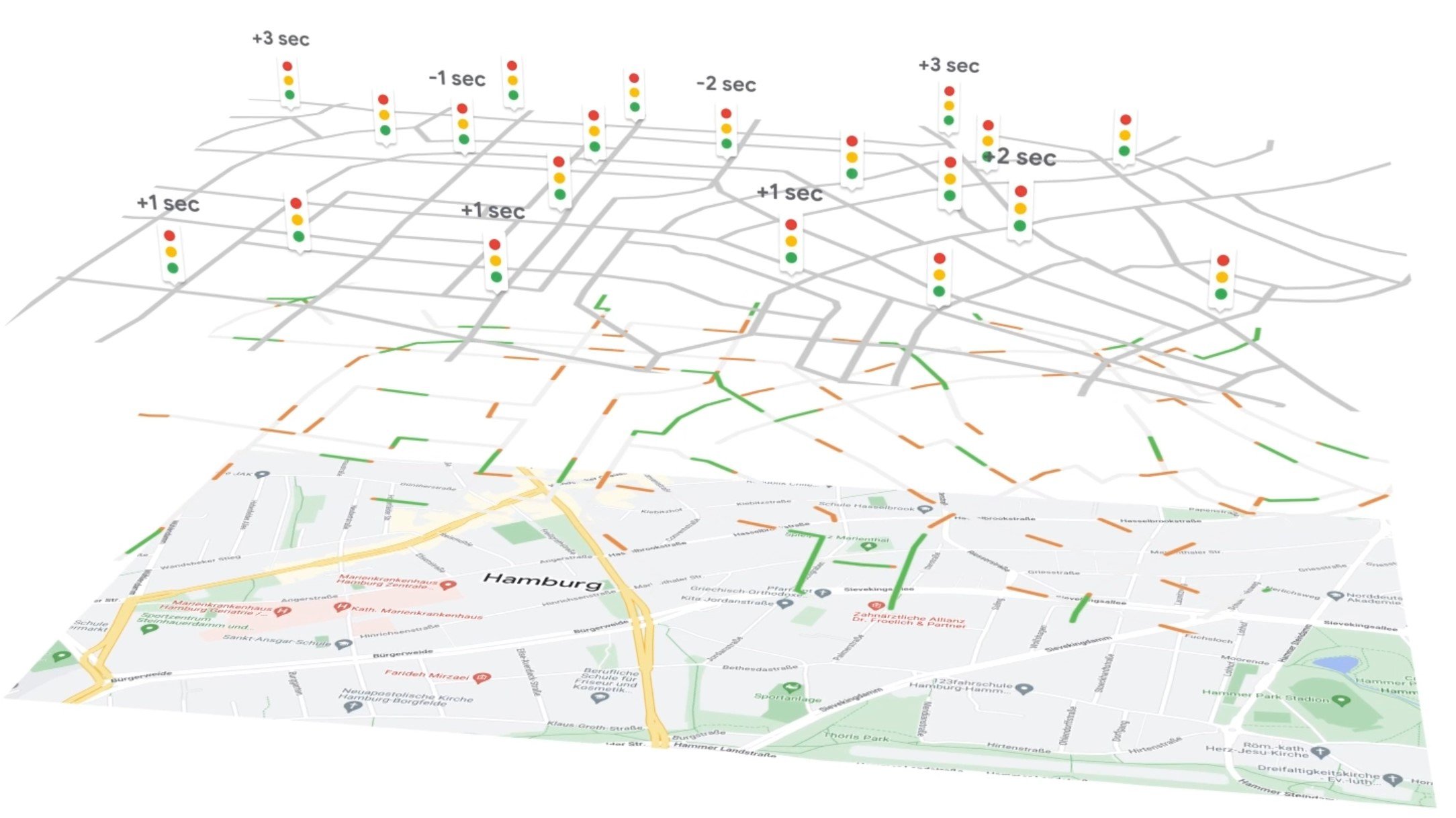
Google developed Project Green Light, an AI-powered solution that optimises traffic signal timing using insights from Google Maps driving data.
How it works:
- Data Analysis:
The system analyses large-scale, anonymised traffic patterns from Google Maps to identify congestion hotspots.
- AI Modelling:
Machine learning models simulate traffic flows and detect inefficiencies at intersections.
- Optimisation Recommendations:
The system generates actionable recommendations—such as adjusting signal timing or coordinating intersections to create “green waves”.
- Easy Deployment:
Cities can implement these changes in minutes, using existing infrastructure—no new hardware required.
- Continuous Improvement:
Performance is monitored and refined through ongoing data analysis and feedback loops.
Global deployment
Project Green Light is already deployed in 20+ cities across Europe, Asia, the Middle East, and the Americas, demonstrating its scalability across diverse urban environments.
Cities include:
- Europe: Hamburg, Budapest, Manchester
- Middle East: Abu Dhabi, Haifa
- Asia: Bangalore, Hyderabad, Kolkata, Jakarta, Bali
- Americas: Rio de Janeiro, Seattle, Boston, Québec City
The solution is already influencing tens of millions of car journeys per month, highlighting its ability to deliver impact at scale.
- Quantified Benefits
Early deployments show measurable and scalable impact:
- Up to 30% reduction in vehicle stops at intersections
- Up to 10% reduction in emissions at optimised intersections
- Reduced fuel consumption and congestion across urban networks
- No need for new infrastructure investments
Additional benefits include:
- improved travel time and traffic flow
- lower operational costs for cities
- rapid scalability across regions
- Why This Matters
This use case demonstrates how digital technologies can unlock system-level efficiency gains in infrastructure-heavy sectors.
Key insights:
- AI enables real-time optimisation of complex urban systems
- Data-driven solutions can deliver immediate emissions reductions
- Scalable, low-cost deployment accelerates adoption globally
Most importantly, it shows how digital innovation can translate into measurable, real-world impact, aligning with the Digital with Purpose approach of moving from ambition to implementation.
Become a member and get access to all special member content with the best insights of tech and sustainability issues today.