
Member Spotlight – SEE Holding: Building Sustainable Cities as Living Systems
How a GeSI member is combining urban design, clean energy, circular resource systems and digital intelligence to make low-emission urban living measurable and replicable.
The challenge: cities need systems that work together
Cities sit at the intersection of many sustainability challenges: energy, water, buildings, mobility, food, waste, public health and community wellbeing. These systems are closely connected in daily life, but are still often planned, financed and managed separately.
This fragmentation limits progress. Solar panels or electric-vehicle chargers can help reduce emissions, but they cannot by themselves make a city resource-efficient, resilient or affordable. Lasting improvements depend on how buildings reduce demand, how water and waste are managed, how people move, and how infrastructure responds to changing conditions.
The challenge is therefore not only to deploy greener technologies, but to design urban systems that work together, measure their performance and improve over time.
SEE Holding’s approach: treating the city as an operating system
GeSI member SEE Holding is a Dubai-headquartered development and investment company focused on the design, development and scaling of sustainable cities. Its model brings together urban planning, development and investment around three linked dimensions of sustainability: environmental, social and economic performance.
At the centre of this approach is The Sustainable City, first developed in Dubai as a live model for low-emission urban living. Rather than treating sustainability as a collection of separate features, the model integrates six areas into the masterplan: food, energy, water, products, mobility and waste.
This means reducing resource demand before adding technical solutions. Passive building design helps lower energy use; water-saving fixtures, smart irrigation and wastewater reuse reduce water consumption; and car-free residential clusters, electric mobility infrastructure, waste separation and local food production are planned as connected elements of the community.
The aim is to link environmental performance with practical outcomes for residents, including lower operating costs, accessible public spaces and a healthier urban environment.
From concept to evidence: The Sustainable City – Dubai
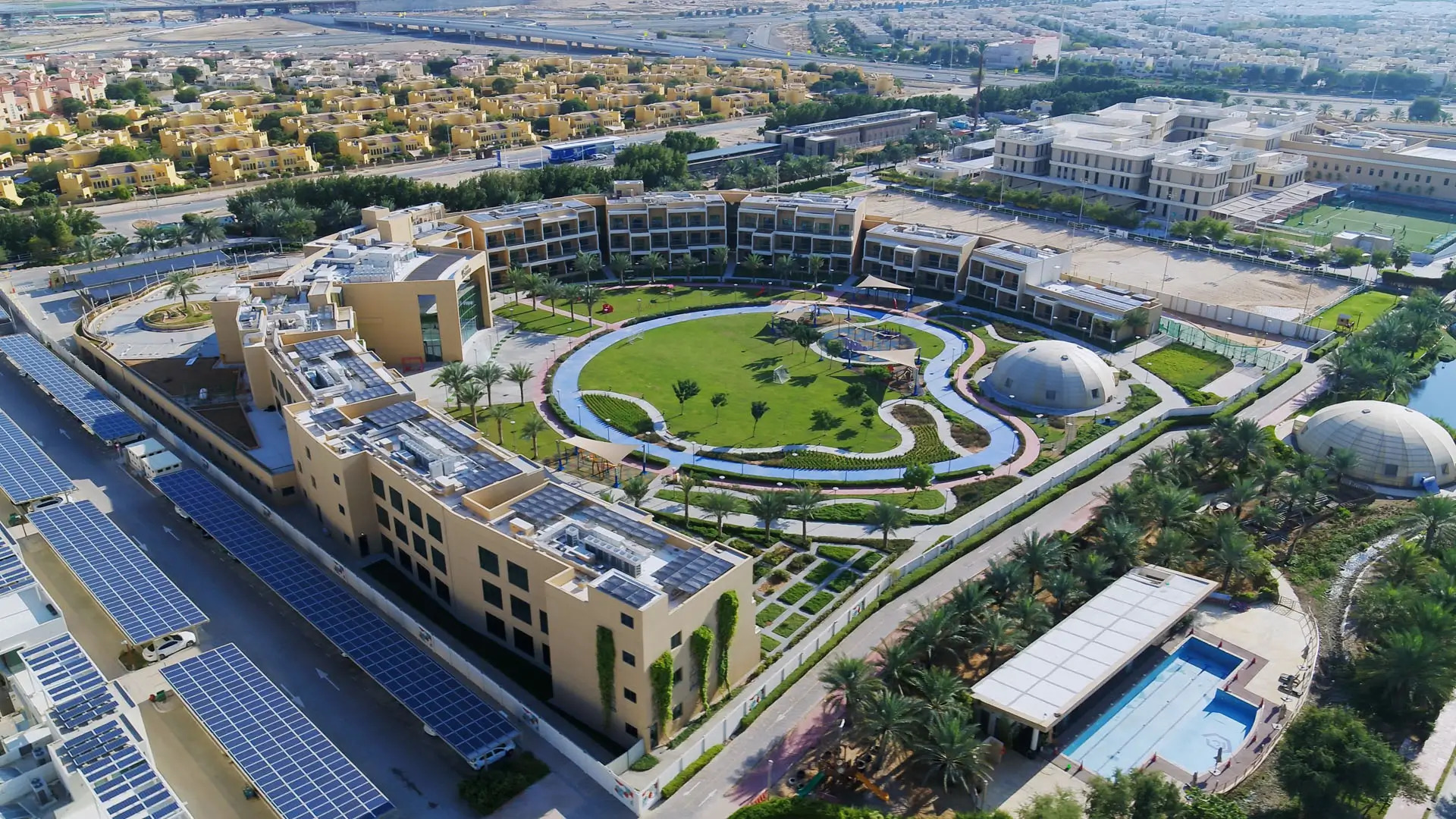
The Sustainable City – Dubai integrates renewable energy, productive landscapes, walkable neighbourhoods and community infrastructure within a single urban model.
The Sustainable City – Dubai became operational in 2016 as the first live demonstration of the model. The five-million-square-foot development combines residential neighbourhoods with solar generation, urban farming, water reuse, electric mobility, and community infrastructure.
According to SEE Holding, the community has achieved a 78% reduction in carbon emissions and diverted 89% of waste from landfill. It also reports electricity-bill savings of up to 60%, water consumption around 40% lower than conventional use through efficient fixtures, and the treatment and reuse of wastewater for irrigation.
These reported outcomes illustrate why integrated design matters. Reducing energy and water demand can lower household costs, while walkable neighbourhoods, green spaces, local food production and shared facilities can contribute to wellbeing, inclusion, and social cohesion.
The project offers a useful lesson: environmental performance is more likely to endure when it is designed alongside quality of life and economic value, rather than treated as a separate objective.
Digital intelligence: supporting continuous improvement
SEE Holding is extending this approach through The Sustainable City 2.0, a next-generation model intended to integrate AI, automation and smart infrastructure more deeply into urban operations.
The proposed model includes real-time monitoring and automation across vertical farming and precision agriculture, energy management, water leak detection, irrigation optimisation, waste management, and electric mobility. The objective is to help systems respond to changing demand, use resources more efficiently, and maintain environmental performance over time.
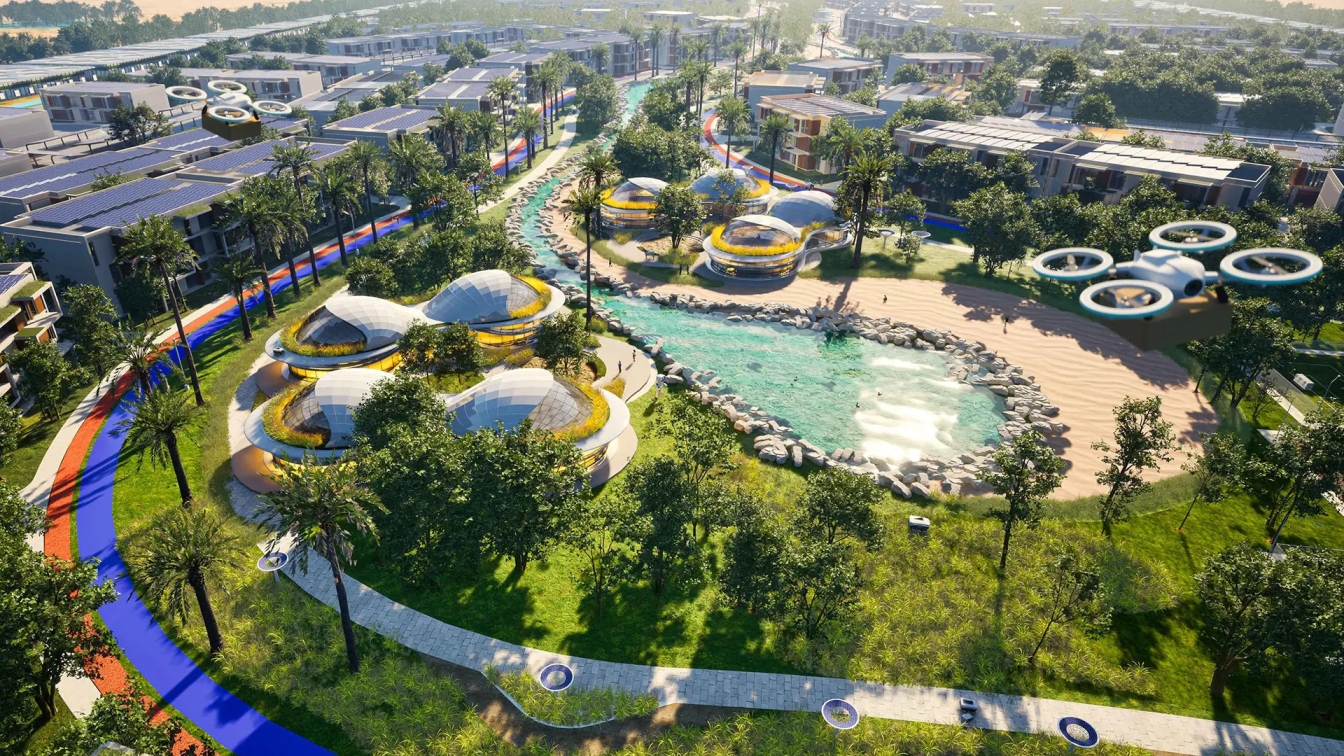
Concept visuals of The Sustainable City 2.0, SEE Holding’s proposed AI-driven, net-zero and human-centric urban model.
SEE Holding has also partnered with robotics and AI company at Micropolis to explore infrastructure-level applications, including edge-computing nodes, intelligent mobility, automation and safety systems. The existing Sustainable City has served as a testing environment where technologies can be assessed in real urban conditions before wider deployment.
This is an important distinction for sustainable digital transformation. A smart city should not be assessed by the number of connected devices it deploys, but by whether digital systems lead to measurable improvements: lower energy and water use, less waste, stronger resilience, and better services for residents.
Buildings as active parts of the urban system
The SEE Institute, located within The Sustainable City – Dubai, demonstrates how this systems approach can extend to individual buildings.
The 5,000-square-metre building generates renewable energy equivalent to around 300% of its own energy demand. SEE Holding intends to offset both embodied and operational emissions by 2030. It also includes a biogas-based waste-to-cooling pilot designed to contribute approximately 40% of the building’s cooling requirements.
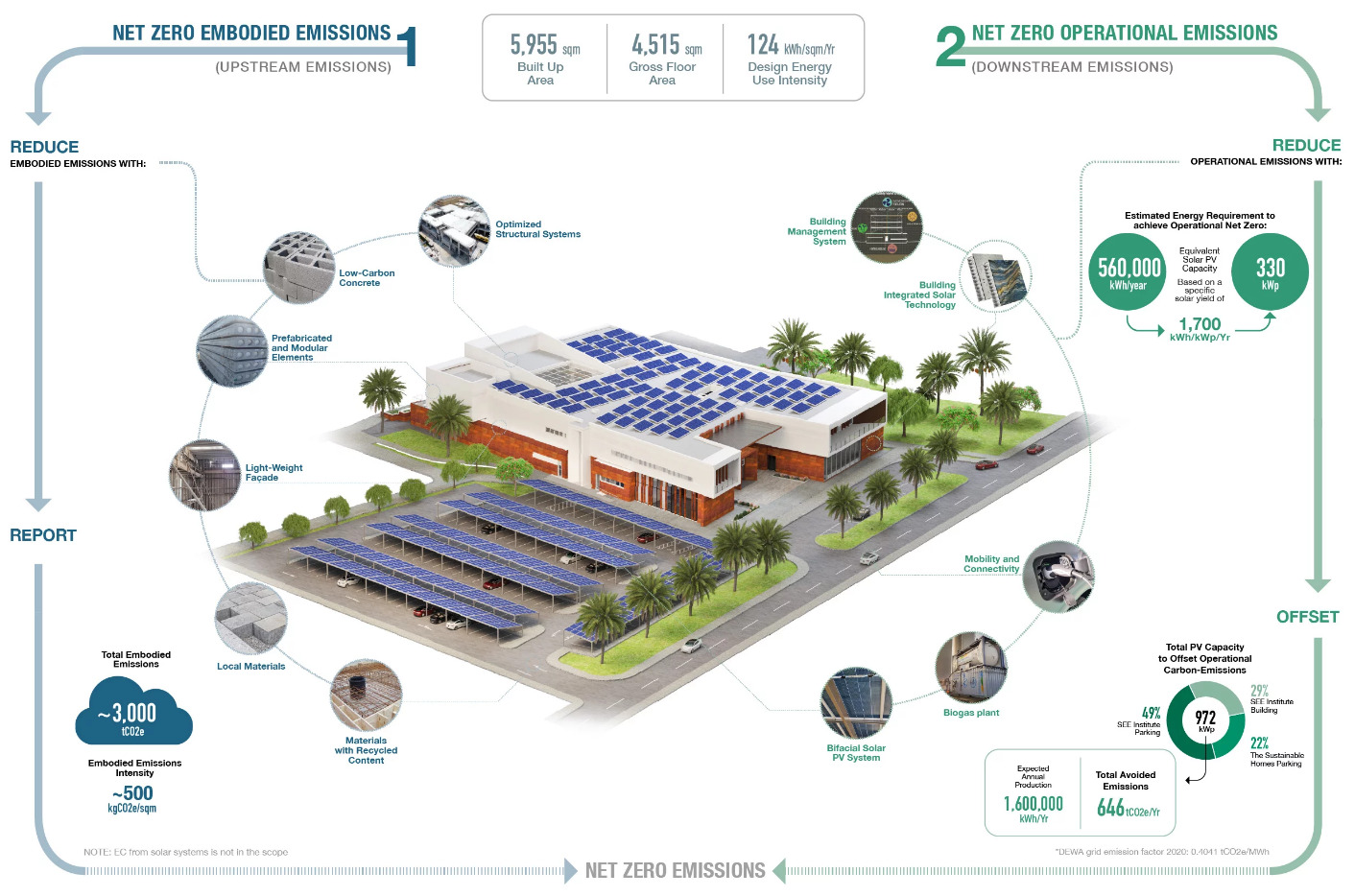
SEE Institute combines low-carbon materials, integrated solar technologies, building management systems, and biogas-based cooling within a whole-lifecycle net-zero approach.
The project reframes the role of buildings in the city: not only as energy consumers, but as active contributors to energy generation, circular resource use, research and education.
Replication without uniformity
The Sustainable City model has expanded from Dubai to Sharjah and Abu Dhabi, while a new development is under construction in Yiti, Oman. Across its current portfolio, The Sustainable City reports 384 hectares of development, 5,392 residential units and a planned population of approximately 29,000 residents.
The Sustainable City – Yiti applies the same six environmental pillars while adapting them to Oman’s climate and development priorities. The project targets a 78% lower per-capita carbon footprint than conventional housing in Oman, alongside 100% renewable energy, full water recycling, complete diversion of waste from landfill and up to 80% food self-sufficiency. These remain project targets as construction progresses towards the planned 2027 handover.
Replication does not mean that every city should look the same. It means that an integrated sustainability framework can be adapted to local climatic, economic, and social conditions while retaining clear and comparable objectives.
Why it matters
SEE Holding’s work shows that sustainable cities are not built around a single technology or intervention. Their performance depends on how design, infrastructure, renewable energy, circular resource management, digital intelligence, and community participation are brought together.
For the wider GeSI community, the case also reinforces the role of digital technologies as enablers. AI, sensors, data platforms and automation create value when they help physical systems perform better and when their contribution can be measured against environmental, social, and economic outcomes.
As this model expands, transparent and comparable measurement will remain essential. Stronger evidence of what works can help cities, investors and technology providers scale urban solutions responsibly—and ensure that digital innovation serves a clear public purpose for people, businesses and the planet.
Become a member and get access to all special member content with the best insights of tech and sustainability issues today.