
Building Resilient Supply Chains through the Power of AI and Trusted Data
By NEC
- Miki Sato, Senior Director, GX Business Development Department;
- Yutaka Okano, Director, Supply Chain Sustainability Management Department and
- Koichi Noguchi, Manager, GX Business Development Department
Why Supply Chain Resilience Matters Now
Global supply chains are becoming increasingly complex and unpredictable. Geopolitical tensions, resource scarcity, climate-related disruptions, and rapidly evolving regulations are reshaping supply chain priorities worldwide. Today, supply chain resilience is no longer only about recovering from disruptions, it is about continuously sensing risks, adapting decisions, and collaborating across value chains before disruptions occur. In this environment, resilience has become a key driver of long-term competitiveness, growth, and sustainability.
NEC’s Vision: Using AI to Build More Resilient Supply Chains
NEC believes the next generation of resilient supply chains will be powered by three pillars: AI-driven intelligence, trusted data ecosystems, and cross-industry collaboration. By transforming fragmented data across industries and supply chains into actionable intelligence, AI can help organizations become better informed about emerging risks and how they can navigate them. This vision guides NEC’s efforts to help strengthen resilient supply chains as enablers.
Mitigating Supply Chain Uncertainty through Circularity
Circularity strengthens supply chain resilience by reducing dependence on virgin materials and diversifying sources of supply. These capabilities help organizations respond more effectively to supply disruptions while advancing decarbonization goals. NEC is developing a Circular Materials AI portfolio including Materials Informatics, alongside trusted data-sharing technologies to support circular material value chains.
Our portfolio aims to increase the utilization of recycled materials while maintaining the quality required for industrial applications such as automobile manufacturing.
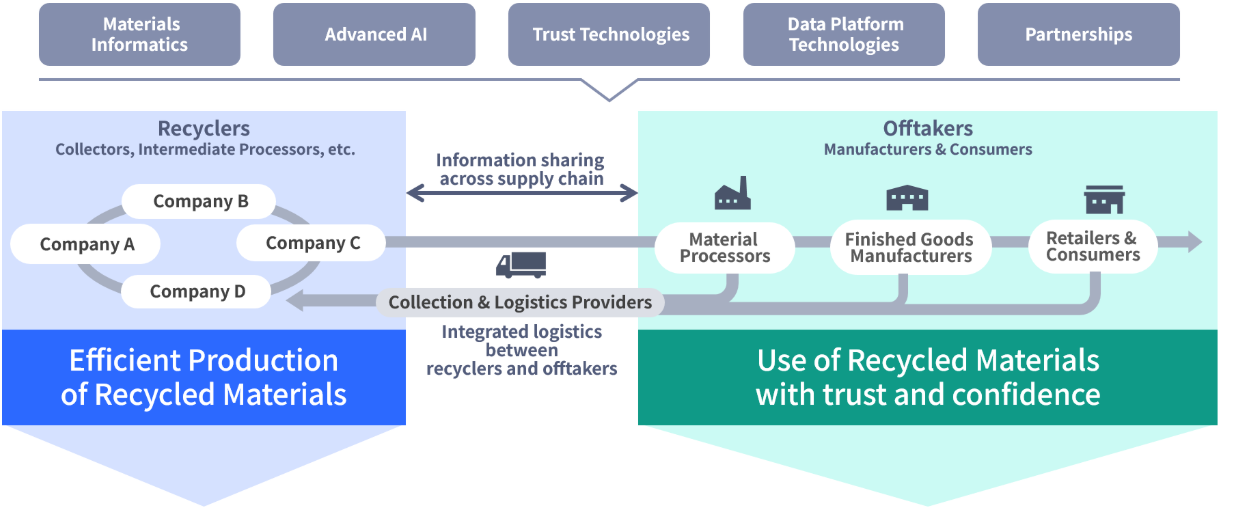
As part of Japan’s Strategic Innovation Promotion Program (SIP) on Circular Economy Systems, NEC is developing PLA-NETJ, a plastic information-sharing platform that supports traceability and information exchange across circular value chains through Digital Product Passports (DPPs) and trusted data exchange. PLA-NETJ is currently undergoing demonstration trials towards social implementation. Together, these technologies help build circular material ecosystems that are more transparent, connected, and scalable.
One application of Circular Materials AI is light-metal recycling. In proof-of-concept demonstrations, AI-assisted optimization increased the recycled aluminum content by up to 60% while reducing manufacturing costs by up to 20%. Compared with primary aluminum production, producing aluminum from recycled materials can reduce CO₂ emissions by up to 97%, making it a key to decarbonization. NEC is also participating in the Toyama Circular Economy Model Creation Project led by the University of Toyama. The project is part of COI-NEXT, a research and innovation program of the Japan Science and Technology Agency (JST) and supports more efficient circular use of aluminum.
Similar approaches are being applied in recycled plastics manufacturing, where NEC uses Materials Informatics (MI) to address inconsistent material quality – a key barrier to circularity. Demonstrations with recycling and manufacturing partners in Japan showed that our MI technologies reduced the work time required for compounding by up to 50%. Maintaining sufficient quality in recycled plastic compounding requires a high level of craftsmanship and is a bottleneck for the expansion of the circular ecosystem. NEC’s MI technologies assist compounders by recommending optimized compounding recipes. Building on these results, NEC is now selected as a member of a national project supported by Japan’s Ministry of the Environment, to further improve quality stabilization and manufacturing efficiency and scale the application of this technology.
Turning Environmental Information into Business Insights through AI
Organizations are increasingly exposed to nature- and water-related risks that can affect supply chain performance and business continuity. To help address these challenges, NEC combines AI, advanced analytics, and environmental expertise to deliver large-scale and location-specific environmental risk assessments. The solution analyzes diverse environmental information, including hydrology, water infrastructure, local stakeholders, and regulatory conditions, to identify risks across operations and supply chains. A key differentiator of this approach is its ability to translate environmental information into business and financial insights, helping organizations navigate risks and make investment decisions accordingly.
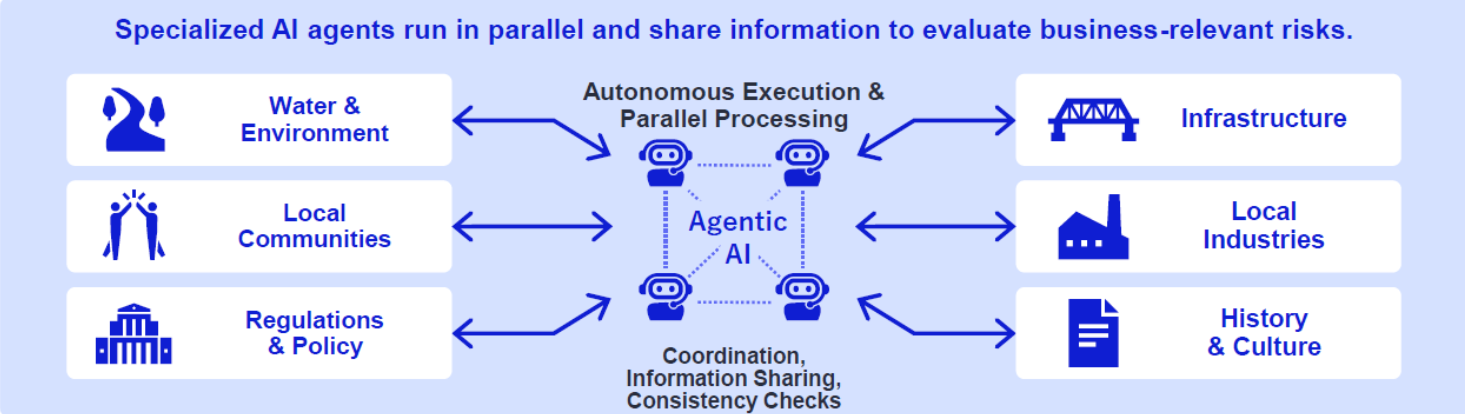
This approach has been applied to assess environmental risks across approximately 2,000 supplier locations and 20 data centers worldwide. The solution has automated work equivalent to more than 80,000 human hours while providing a more comprehensive and consistent understanding of location-specific environmental risks. The resulting insights support NEC’s TNFD-related assessments and disclosures, reducing the time required for analysis and reporting by approximately 92%.
Looking Ahead
As supply chains continue to face increasing uncertainty, organizations are required to better anticipate risks, prepare themselves for disruptions, and position themselves in the resilient ecosystem more than ever. NEC believes AI, trusted data, and digital ecosystems will play a critical role in navigating this shift. By enabling material circularity, strengthening collaboration across value chains, and helping organizations better understand supply chain risks, NEC aims to support supply chains that are more resilient, adaptive, and sustainable. Guided by our Purpose to create the social values of safety, security, fairness, and efficiency, NEC will continue to work with partners across industry, academia, and the public sector to advance digital innovation that helps build resilient supply chains for the future.
Become a member and get access to all special member content with the best insights of tech and sustainability issues today.