
Globant: Unlocking the Value of Circular Water Through Science, Digital Innovation & Cross-Industry Collaboration
Industries worldwide are running out of viable water solutions. The old linear model—withdraw, use, dispose—is too costly, too carbon-intensive, and no longer sustainable. Globant and Xylem have created a breakthrough circular water system that treats and reuses produced water, cutting freshwater demand by up to 33% and reducing emissions by around 20%. The science-based model shows up to USD 12 million in annual savings, and with AI-driven monitoring and optimisation, it can unlock safer, smarter, and more resilient operations. This is a scalable blueprint for any water-intensive industry—proving that sustainability and profitability can accelerate each other.
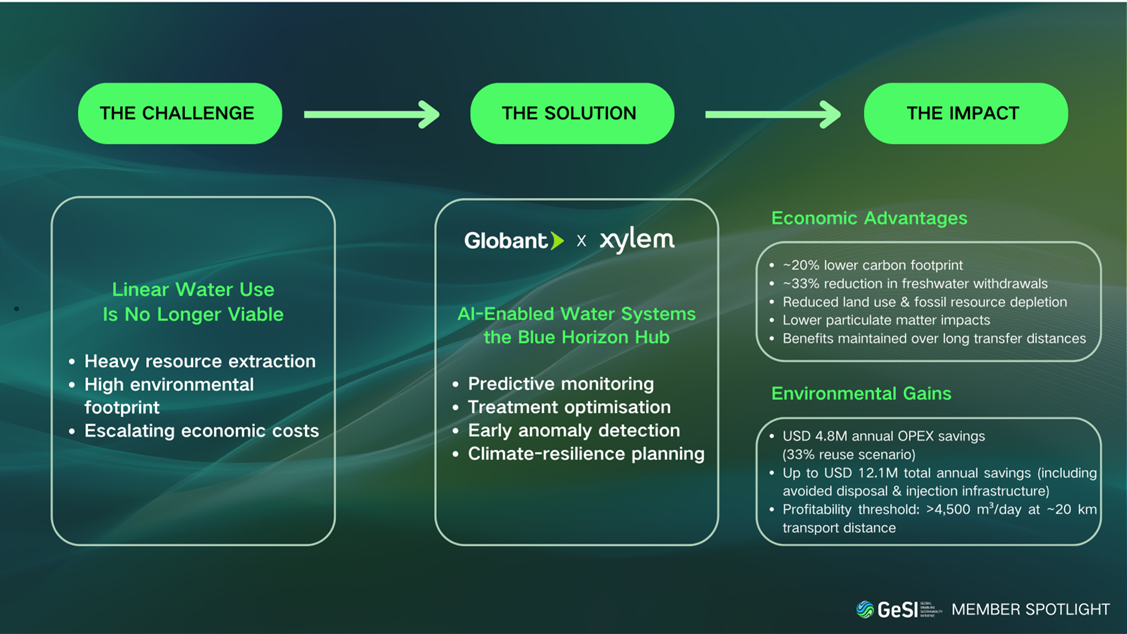
THE CHALLENGE
Linear Water Use Is No Longer Viable: In the oil and gas sector—especially in hydraulic fracturing—water consumption and wastewater management pose critical environmental and economic challenges. The traditional linear model (withdraw → use → dispose) is proving unsustainable on multiple fronts:
- Heavy resource extraction: Operations require substantial freshwater withdrawals.
- High environmental footprint: Significant carbon emissions and waste generation accompany disposal.
- Escalating economic costs: Wastewater disposal and injection-well infrastructure drive high OPEX.
As water scarcity intensifies and regulatory pressures increase, the sector urgently needs scalable, cost-efficient, and climate-aligned alternatives.
THE SOLUTION
Globant’s Approach – Scientific Rigor Meets Digital Innovation: To address this, Globant brought together its AI-powered Sustainable Business Studio with Xylem’s deep water-technology expertise—forming a cross-industry partnership capable of capturing the full operational, environmental, and financial dimensions of circularity.
They conducted an integrated Life Cycle Assessment (LCA) and economic evaluation to compare linear vs. circular water management systems. The study assessed more than 10 environmental impact categories under EN15804 standards, alongside detailed CAPEX and OPEX modeling.
The project introduced produced water treatment and recirculation technologies to enable reuse within fracturing operations. Key innovations included:
- Advanced treatment of flowback and produced water for reuse.
- Up to 33% water recirculation, lowering dependence on freshwater sources.
- Predictive economic modeling to define profitability thresholds (savings achieved above 4,500 m³/day at 20 km transfer distance).
The analysis is highly transferable. Because the model is science-based and system-agnostic, it offers a roadmap for water-intensive industries such as: Mining, Energy, and Manufacturing. These sectors face similar linear-water challenges and stand to benefit significantly from circular models.
Advancing Toward AI-Enabled Water Systems
Looking forward, Globant is integrating AI Agents to support:
- Predictive monitoring
- Treatment optimisation
- Early anomaly detection
- Climate-resilience planning
Together with Xylem, the partners are developing the Blue Horizon Hub, including an Orchestrator Agent to coordinate multiple AI agents across a water network—unlocking system-wide efficiency, safety, and resilience. This signals a new phase of AI-enabled circular water management.
THE IMPACT
Benefits for Both the Environment and Business: The findings show that circular water systems are not only environmentally superior—they are economically compelling.
1)Environmental Gains
Circular systems deliver improvements across ~90% of evaluated categories, including:
- ~20% lower carbon footprint (102.6 → 82.1 kg CO₂e per m³)
- ~33% reduction in freshwater withdrawals under a 33% reuse scenario
- Reductions in land use, fossil-resource depletion, and particulate-matter formation
Even with extended transfer distances, environmental advantages remain.
2)Economic Advantages
Circularity also generates substantial financial value:
- USD 4.8M annual OPEX savings at 33% reuse
- Up to USD 12.1M in total annual savings when avoided disposal and injection infrastructure are included
- Clear profitability threshold: positive returns above 4,500 m³/day at 20 km transport distances
The data confirms that sustainability and profitability can reinforce one another.
A Model for the Future of Digital Sustainability
Through its collaboration with Xylem, Globant embodies the GeSI vision: leveraging digital innovation, scientific rigor, and cross-industry collaboration to advance intelligent, sustainable, and economically resilient resource systems. This work offers more than a single case study—it provides a replicable model for accelerating the global transition toward circular, climate-resilient, and digitally empowered economies.
Become a member and get access to all special member content with the best insights of tech and sustainability issues today.