
GeSI contributes to the 2nd National Congress on Health and Environment in Lisbon
On 9 April, the Global Enabling Sustainability Initiative (GeSI) participated in the 2nd National Congress on Health and Environment, held in Lisbon at the Fundação Calouste Gulbenkian.
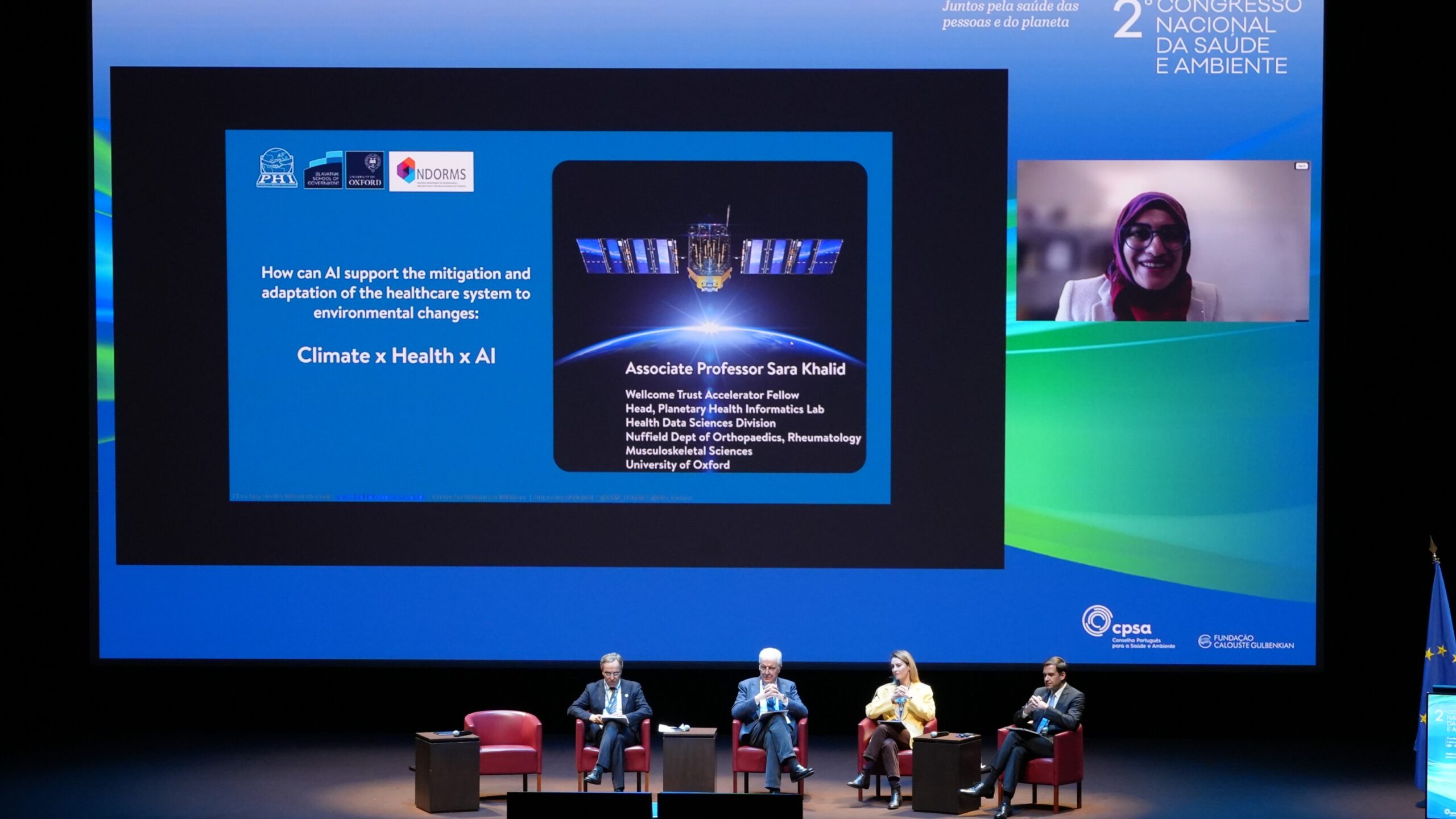
On Screen: Sara Khalid, Oxford University
Panel from left to right: Pimenta Machado, APA; António Vaz de Carneiro, Instituto de Saúde baseado na Evidência (ISBE); Rita Dias, GeSI and Ricardo Baptista Leite, Health AI
The congress brought together a multidisciplinary community of experts, policymakers, and practitioners to address concrete challenges at the intersection of public health and environmental change. With approximately 2,000 participants from over 120 professional backgrounds and more than 100 speakers and moderators, the event reflected the growing strategic importance of the health–environment nexus.
GeSI was represented by Rita Dias, Director of Communications and Marketing and lead of the Digital with Purpose Programme, who joined the roundtable “Como pode a IA apoiar a mitigação e adaptação do sistema de saúde às alterações ambientais?” (“How can AI support the mitigation and adaptation of healthcare systems to environmental change?”).
In her intervention, Rita highlighted key findings from the Digital with Purpose: Smarter 2030 report, which demonstrates that the adoption of existing digital technologies could accelerate progress across the Sustainable Development Goals by an average of 22%, while mitigating negative trends by 23%.

Panel from left to right: Pimenta Machado, APA; António Vaz de Carneiro, Instituto de Saúde baseado na Evidência (ISBE); Rita Dias, GeSI and Ricardo Baptista Leite, Health AI
She emphasized the role of artificial intelligence as a critical enabler of positive, scalable impact in health systems facing increasing environmental pressures. As a concrete example, she showcased a solution from the Digital with Purpose ecosystem: the Huijia Health Non-Invasive Fiber Optic Sensing Platform (NFOP).
This AI-enabled, non-invasive sensing technology transforms everyday surfaces—such as hospital beds, chairs, or medical equipment—into real-time health monitoring systems. Using ultra-thin fiber optic sensors, the platform captures physiological signals and enables the detection of multiple health conditions, including arrhythmias, sleep apnea, respiratory and cardiac conditions, neurological disorders, fatigue, and stress responses. By enabling continuous, remote monitoring, the solution expands access to care while improving efficiency and reducing pressure on healthcare infrastructure.
These applications demonstrate how AI can strengthen the resilience, efficiency, and responsiveness of health systems, while contributing to better outcomes and reduced environmental impact.
Rita also underlined that unlocking this potential requires readiness for implementation. Beyond technological capability, there is a need to ensure that solutions are both effective in addressing real-world challenges and efficient in their deployment at scale. A key barrier remains the gap between public sector needs—particularly in health systems—and the solutions currently available in the market.
GeSI extends its sincere thanks to the Conselho Português para a Saúde e Ambiente for convening this important platform, and to Luís Campos for the invitation and leadership in advancing this critical dialogue.
Become a member and get access to all special member content with the best insights of tech and sustainability issues today.